
Mithunam
Heart-warming tale executed with brilliant actors!

[NB: This post may be truncated by your email service platform. You may directly visit my blog to access the full article.]
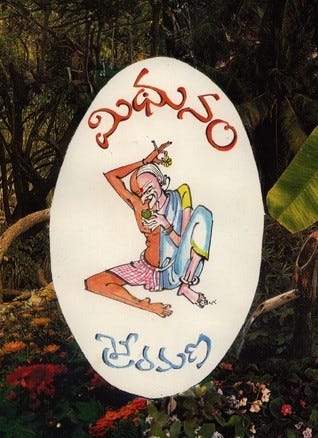
Mithunam is a 2012 Telugu drama film based on the critically acclaimed novel by the same name written by Sri Ramana. The narrative is multi-modal and looks at several aspects ranging from marriage to relationships to old age to life on a longer journey. The craft of bringing the novel to the visual space is a skill in itself, and Tanikella Bharani deserves much credit here. Although the visual allows vast space for experimentation, one must know how to use the space effectively while adding depth to the story and characters. In this sense, Tanikella-gaaru has delivered a visual treat in its rawest form.
(PS. It is in the western culture that we refer to people by their second names; however, in the Indian context, we mostly associate elders with certain titles, else add a title of continuation to their first names. In the Telugu context, we add “gaaru” to the names to indicate our respect.)
Story
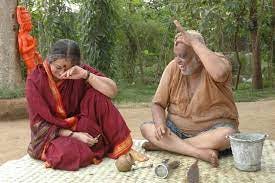
Mithunam is a story of an elderly couple who stay away from the buzzing city life. We see Appadasu, who is now retired, and Buchchi spend their days in absolute solitude. This must not be mistaken as ‘isolation’. The couple’s children are well-educated, married and settled outside the country. The husband and the wife reside in their self-sufficient home. It appears as though the couple have managed to fulfill their duties towards their children, and are now spending the rest of their lives in caring for each other. The entire narrative is filled with gentle romance between the two to their wittiness and minute tiffs; while also weaving in the utmost love and respect they have for each other.
About the Movie
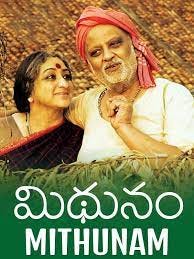
The movie features just two characters, Appadasu (played by S.P. Balasubrahmanyam-gaaru) and Buchchi Lakshmi (played by Lakshmi-gaaru); and it is around and through them that the entire narrative is built. Translating Mithunam would simply mean “couple”, and so is the central theme of the story, which yields to sub-themes such as family and attachments. The elderly couple reside in a house with reasonably large self-sufficient farm around the house. The abundance of nature and an endearing cow (Savithri) with her son (calf - Anji) picture as stand alone characters here. Their presence in the discourse adds great weight to the conversations between Appadasu and Buchchi.
The movie is one of its kind for its minimal characters. The linear narrative ensures the growth of the characters while also portraying the different life experiences in a two-hour narrative. If Samuel Beckett’s Waiting for Godot exemplifies the ‘theatre of absurd’, then Mithunam exemplifies the essence of spiritual connect in the Indian context. The existentialism here is stalled by reducing the larger life’s purpose and questions into actions and conversations at a very regular level.
Although the star characters are only two in number, Tanikella-gaaru’s direction is such that the setting amplifies the narrative agency on the whole. We do not see the farm or cattle or objects as separate entities, rather, we see a co-existence in the sphere. It is perhaps this co-existence that brings balance to the narrative, and largely to the meaning of life. The spiritual connect which is touched is purely through the relationships between humans; human and nonhuman animals; humans and objects; and humans and nature.
What is integral in this movie is its portrayal of nature and culture as codependent entities. They are not pitted against each other, instead the two terms are elaborated thoroughly in the narrative as entities that bear the potential to dissolve in each other. The nature here is attended by the couple, and in return the nature provides them abundantly. The culture here is one that runs against the big capitalistic styles of living, and imbibes a simple living following a few traditional customs where nature is respected by the culture. The binary between the two is significantly merged under the context of codependency and coexistence. Therefore, throughout the movie, we tend to see the elements of nature in jump-cuts casually interweaving with the two significant characters.
Apart from this, the dialogues and music tracks add a unique charm to the rendezvous of the elderly couple. The screen-script appears to be written with such care that it is almost impossible to discard even the trivial conversations. While the grand dialogues probes us to look at life lively, there are those little ones with which we relate to completely. The beauty of the film is that there are no greater degrees of sadness or excitement, and that the effectiveness lies in just ‘a little’ alterations and variations in the tone of sentiments.
What is so special about this elderly couple?
“Dappalamu, daampathyamu marigina koddi ruchi.”
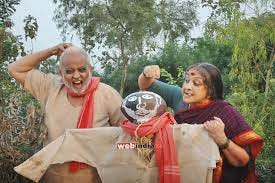
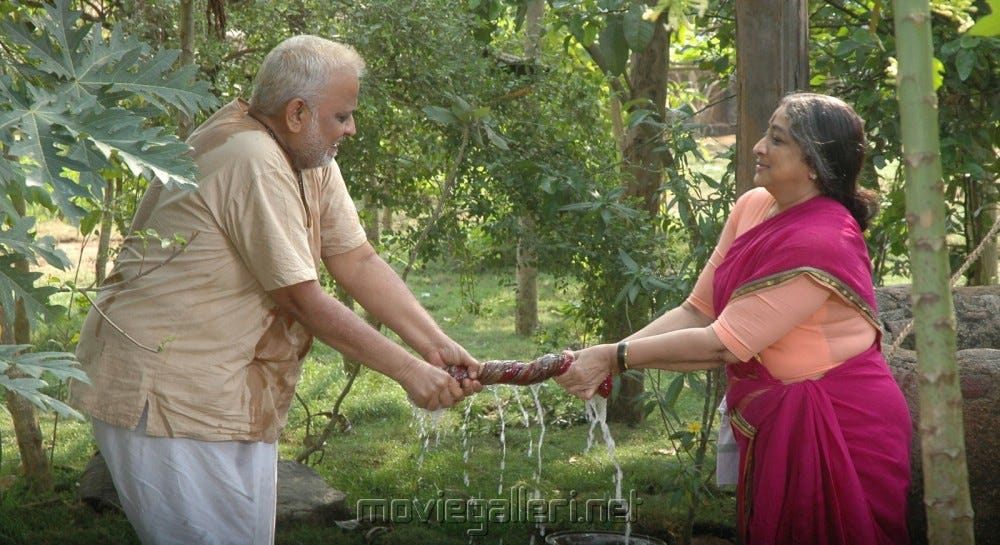
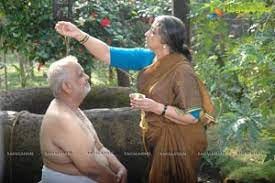
Appadasu and Buchchi are sheer poetry together. The image of ardhanaareeshwara, where the wife completes the husband is befitting in this context. One cannot imagine a discourse without either of them absent in the frame. Even in the absence of dialogues, we see a rare but compelling chemistry between Appadasu and Buchchi (of course, the actors - SPB-gaaru and Lakshmi-gaaru - have brilliantly performed). This elderly couple is not quiet, that is, they ensure to keep one another engaged day after day. If Buchchi indulges in cooking varieties of food, Appadasu engages in minor labours, such as pottery making, gardening, attending to the cattle, and so on. We see independent individuals who also need each other to depend on. It is quite a tautology one would think, but the truth is simple - communication of all sorts make a relationship work. We do not see a couple who “adjust” with each other; instead, we see a couple who have embraced each other as they are with their flaws and quirks.
Appadasu and Buchchi send out a great message in terms of sustaining relationships.
Appadasu
“Andharu veru, Appadasu veru!”
Appadasu is an energetic character. As audience, we have no choice but to simply fall in love with him. He has the innocence of a child which melts Buchchi’s heart, and the mischievous man-child that he is keeps her occupied. Appadasu comes across as a real-life example of “sustaining” a marriage. He knows and believes that one need not have to win wars or profess bravery to earn his wife’s love; instead, he revels in little things that bring out the depth of romance between the two. For instance, when Buchchi tells him that he does not know about her saris, Appadasu immediately begins to list the little anecdotes associated with each of Buchchi’s sari. It is in habits like these that Appadasu becomes a lesson to the seemingly work-pressurised and unromantic husbands. He places his efforts is in respecting the significant-other, and perhaps in appreciating every little thing that Buchchi does for him.

Buchchi Lakshmi
“Manishiga puttadam telikenaiyya, manishiga badhakadave kastam… (Buchchi shows her gratitude towards Appadasu by folding her hands before him)”
It is Buchchi who balances the house with her endearing nature with Appadasu, and matured discourse with the rest of the chores. Buchchi knows to keep Appadasu on his toes, and she conveys a great deal of compassion and affection towards her husband. She knows to irritate Appadasu (mostly by bringing up the “drakshala sambandam” whenever they fight) and also to soothe him when he is in pain. Buchchi is that typical wife whose world is her husband and home; however, we do not see a compromised housewife here but a really happy one. While Appadasu is credited with beginning conversations or situations, Buchchi holds great weight in shaping these discourses into entertaining ones. Her love for Appadasu is immense and, at times, we see that Buchchi does not just adore her husband but worships him. She comes across as a great example for kindness and patience, qualities that are deteriorating in the present times.
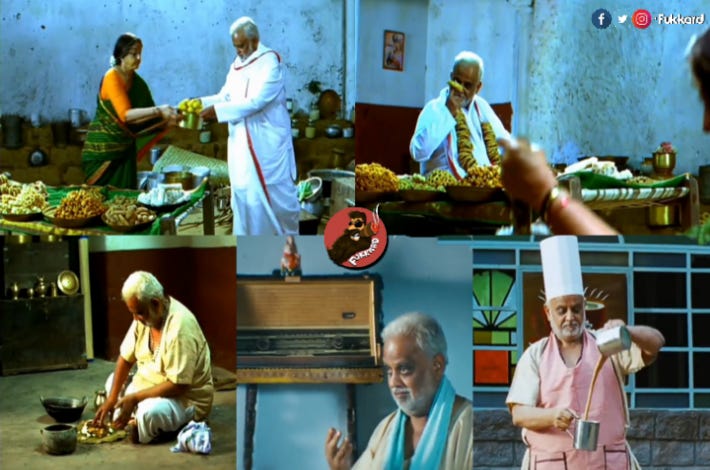
Food
Food is an integral element in the entire narrative of Mithunam. We see the couple using vegetables and fruits from their own garden, and asserting on the essence of tasty and healthy meals. This is often reiterated by Appadasu’s famous counter, “adbhutaha”.
“Annam sarva prapanchaniki athi mukyamaiyindhi kada… ante annam para-brahma swaroopam annamaata.
Buchchi, naaku modati muddha ‘spatika lingam-la’ anthunde… dhaniki neyi tho abhishekam chesthan, aavakaayi tho botteduthan, kottimera dandamesthan, pappu tho naivedhyam pedthan, chivariki - perugu tho shuddhi chesi ‘aatma lingam-lo’ kalupukuntan.”
The factor of associating food with god and giving it the due respect that it deserves is weaved really well into the lives of Appadasu and Buchchi. This, in fact, asserts upon the importance of food and how it strengthens not just individuals but their relationship with others. Food, here, is seen as a reviving aspect, and that alone has the power to help sustain the bond between the couple.
Death
“Andharu eppudo okka apdu vellavaalsinde, kaastha mundhu venaka anthe.”
Another significant theme is death in Mithunam. Whenever Appadasu talks to Savithri (the cow), he often emphasises on “attached-detachment”. This is indeed a significant teaching for attaining complete spiritual connect. A line of detachment is always necessary for a relationship to blossom vastly. This could be associated with people and with people’s attachment to objects. Only a thin line of detachment can prevent a healthy relation from turning into a toxic one. While the theme of death runs as an undercurrent in the narrative, it does not disrupt the flow or keep the audience on their toes in terms of anticipation. Instead, death is welcomed like an old friend here, and leaves with a filled heart.
Songs
The music tracks amplify the relationship between Appadasu and Buchchi. Every song is literally a treat to the senses. They are soothing, meaningful and brimming with truth and reality of life.
[I have added the tracks here, enjoy listening to these musical delights!]
Song Number 1: “Aadi dampathule abhimaninche, achha telugu midhunam…”
Song Number 2: “Coffee dandakam”
Song Number 3: “Ammyya dorikyava ardha-naareshwaruda…”
Song Number 4: “Aavakaayi mana andharidhi…”
Song Number 5: “Aatagadara shiva, aatagada keshava, aatagadara neeku amma-todu…”
Recommendation
Mithunam is an absolute delight. It is one of my favourite movies, and this is hard for me to accept, but I do feel envious of Appadasu and Buchchi. Well, such is the power of storytelling, and the actors’ performance. The film yields to multifarious explorations and interpretations. It deserves close observation and a sensitised mind. Considering the two legendary actors in the movie, I suggest that you watch Adutha Veetu Kavithai (a Tamil serial starring SPB-gaaru and Lakshmi-gaaru in the lead), and Devastanam (a Telugu drama starring Vishwanath-gaaru and SPB-gaaru in the lead) for more meaningful entertainment.
PS. Do let me know your thoughts on this movie.
Absolutely a treat that gives a whole picture of the movie. Thank you for sharing.